







When you feel your heart skip a beat, flutter, or race in your chest, your mind immediately jumps to a single question: “What is happening to me?”
When you consult a doctor, you expect a straightforward answer—a diagnosis. However, during your appointment, you may hear your cardiologist mention a differential diagnosis.
While these two terms sound almost identical, understanding the distinction between a diagnosis and a differential diagnosis is essential for taking charge of your cardiac health. On PVC HEART, we specialize in helping patients navigate premature ventricular contractions (PVCs), irregular heart rhythms, and overall cardiovascular wellness.
Here is a comprehensive breakdown of what diagnosis vs. differential diagnosis means, how cardiologists differentiate PVCs from other conditions, and what you can expect during a complete heart evaluation.
1. What Is a Diagnosis?
A diagnosis (plural: diagnoses) is the official identification of the specific illness, disorder, or physiological condition causing your symptoms. It is the final conclusion reached by a healthcare provider after reviewing your medical history, performing physical examinations, and evaluating diagnostic test results.
Symptom / Feeling ➔ Clinical Tests & Evaluation ➔ Final Diagnosis
Key Elements of a Medical Diagnosis
- Specificity: It pinpoints the exact health issue (e.g., Isolated Premature Ventricular Contractions, Atrial Fibrillation, or Hypertension).
- Actionable Path: A confirmed diagnosis enables your doctor to create a targeted treatment plan—ranging from simple lifestyle modifications to prescription medications or catheter ablation.
- Prognosis: It provides insights into what you can expect regarding recovery, long-term health, and potential risks.
2. What Is a Differential Diagnosis?
A differential diagnosis is the working list of possibilities that could account for your symptoms before a final conclusion is reached.
When you tell your doctor, “I feel a fluttering in my chest when I sit at my desk,” that single symptom could indicate several distinct cardiovascular or non-cardiovascular conditions. A differential diagnosis is the systematic process of ruling out possibilities one by one until the true culprit remains.
The Medical Detective Analogy: Think of a differential diagnosis as a list of suspects in a mystery. A diagnosis is identifying the actual culprit after gathering all the evidence.
Why Is a Differential Diagnosis Necessary?
- Overlapping Symptoms: Different conditions often present with identical symptoms. For instance, a “skipped beat” feeling can stem from benign PVCs, premature atrial contractions (PACs), anxiety, electrolyte imbalances, or thyroid issues.
- Patient Safety: A thorough differential diagnosis ensures dangerous underlying conditions—such as structural heart disease or severe arrhythmias—are not overlooked.
- Targeted Testing: It helps physicians determine which specific medical tests (such as an EKG, Echocardiogram, or Holter monitor) are necessary.
3. Side-by-Side Comparison: Diagnosis vs. Differential Diagnosis
| Feature | Differential Diagnosis | Final Diagnosis |
| Stage in Care | Early evaluation & investigation phase | Final conclusion phase |
| Number of Possibilities | Multiple potential conditions listed | Single primary condition identified |
| Primary Purpose | Rule out unlikely or dangerous causes | Guide precise treatment & management |
| Driven By | Symptoms, risk factors, and preliminary observations | Definitive test results (EKG, Holter, Echo) |
| Flexibility | Dynamic; changes as test results come in | Stable; updated only if new symptoms develop |
4. How Cardiologists Build a Differential Diagnosis for Heart Palpitations
When a patient in the United States presents with symptoms like chest fluttering, skipped beats, or mild dizziness, a cardiologist constructs a differential diagnosis spanning several categories.
A. Benign Arrhythmias
- Premature Ventricular Contractions (PVCs): Early electrical impulses originating in the ventricles (lower chambers).
- Premature Atrial Contractions (PACs): Early beats starting in the atria (upper chambers).
B. Complex Arrhythmias
- Atrial Fibrillation (AFib): Irregular, chaotic electrical signals in the atria.
- Supraventricular Tachycardia (SVT): Rapid heart rate originating above the ventricles.
- Ventricular Tachycardia (VT): A series of rapid PVCs that can be life-threatening if sustained.
C. Non-Cardiac Triggers
- Electrolyte Imbalances: Low potassium or magnesium levels impacting cardiac electrical conduction.
- Thyroid Dysfunction: Hyperthyroidism accelerating heart rates.
- Anxiety and Panic Attacks: Elevated adrenaline levels causing perceived or actual extra beats.
- Dietary Stimulants: Excess caffeine, alcohol, nicotine, or specific medications.
5. Moving from Differential Diagnosis to Final Diagnosis in PVCs
To narrow down the differential list and confirm a final PVC diagnosis, doctors use a series of structured cardiac tests.
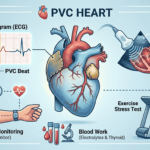
Step 1: Electrocardiogram (EKG/ECG)
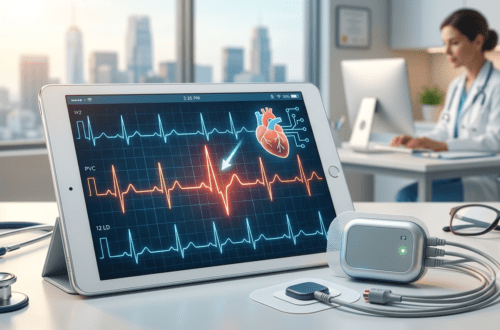
An EKG records the electrical activity of your heart over a few seconds. If a PVC occurs during the test, it displays a distinct wide, distorted QRS complex. However, because occasional PVCs come and go, a standard resting EKG may miss them entirely.
Step 2: Ambulatory ECG Monitoring (Holter & Event Monitors)
To overcome the short window of an EKG, doctors use wearable monitors:
- Holter Monitor: Worn for 24 to 48 hours to continuously log every heartbeat. This measures your overall PVC burden (the percentage of total beats that are premature).
- Event Monitor / Patch Monitor: Worn for up to 30 days to catch intermittent symptoms.
Step 3: Echocardiogram
An ultrasound of the heart that checks structural integrity, valve function, and ejection fraction (pumping strength). This helps confirm whether the PVCs are idiopathic (benign in a healthy heart) or linked to underlying structural heart disease.
Step 4: Cardiac Stress Testing
Monitoring heart rhythm on a treadmill or stationary bike evaluates whether physical exertion triggers or suppresses the irregular beats.
6. Real-World Case Example: Sarah’s Journey
To visualize how this process works, consider a typical patient experience:
- Initial Symptoms: Sarah, a 38-year-old marketing manager, notices a “thumping” feeling in her throat during high-stress workdays.
- Initial Differential Diagnosis: Her physician lists three primary possibilities:
- Option A: Stress-induced Premature Ventricular Contractions (PVCs)
- Option B: Hyperthyroidism causing palpitations
- Option C: Generalized Anxiety Disorder with physiological arousal
- Diagnostic Testing:
- Blood tests reveal normal thyroid and electrolyte levels (ruling out Option B).
- A 24-hour Holter monitor captures 3,200 premature beats originating in the right ventricular outflow tract (RVOT).
- An echocardiogram shows normal heart structure and a healthy ejection fraction.
- Final Diagnosis: Benign Premature Ventricular Contractions (PVCs) with a 3.1% burden, stress-exacerbated.
With a clear final diagnosis, Sarah’s doctor offers reassurance, recommends cutting back on afternoon espresso, and suggests stress reduction strategies rather than invasive procedures.
7. Why Accurate Diagnosis Matters for PVC Patients
Distinguishing between conditions during the differential stage prevents two major risks:
- Under-treating Malignant Arrhythmias: High PVC burdens (typically over 10% to 15% of daily beats) can weaken the heart muscle over time, potentially leading to PVC-induced cardiomyopathy. Catching this early allows doctors to treat it effectively with beta-blockers or catheter ablation.
- Over-treating Benign Palpitations: For the vast majority of people with a healthy heart, occasional PVCs are completely harmless. Knowing you have benign PVCs rather than a dangerous heart defect relieves health anxiety, which itself is a known trigger for extra beats.
8. Questions to Ask Your Doctor
When seeking clarity about your heart symptoms, use these targeted questions during your appointment:
- “What conditions are currently on your differential diagnosis list for my symptoms?”
- “Which tests will help us narrow down the exact cause?”
- “Is my heart structure healthy based on my imaging tests?”
- “What is my daily PVC burden percentage?”
- “Do these irregular beats require medication, or is lifestyle modification sufficient?”
Key Takeaways
- A differential diagnosis is a preliminary list of potential causes for your symptoms.
- A final diagnosis is the confirmed condition identified after objective testing.
- Heart palpitations can stem from PVCs, PACs, thyroid issues, stress, or caffeine intake.
- Wearable monitors (Holter/Event monitors) and Echocardiograms are the primary tools used to confirm a PVC diagnosis.
- Identifying the precise cause ensures proper management and peace of mind.
Disclaimer: The information provided on PVC HEART is for educational purposes only and should not replace professional medical advice, diagnosis, or treatment. Always seek the advice of your physician or qualified cardiologist with any questions regarding a medical condition.

![alt="8K UHD realistic infographic photograph of a healthy American woman and daughter preparing a colorful, anti-inflammatory meal in a sunlit kitchen. An integrated data dashboard explicitly defines: 'Best Nutrition for Heart Rhythm & PVCs,' 'Optimize Electrolytes (Magnesium, Potassium),' 'Adopt Anti-Inflammatory Diet,' and 'Avoid Dietary Triggers (Sugars, Processed Foods, Excess Caffeine).' Features a '[Medically Reviewed]' trust seal."](https://pvcheart.com/wp-content/uploads/2026/07/Gemini_Generated_Image_dhxfq4dhxfq4dhxf-75x75.png)
![alt="8K hyper-realistic photograph inside a modern US electrophysiology clinic. A compassionate female cardiologist with PVC HEART branding on her lab coat points to a high-resolution monitor displaying an ECG tracing with an isolated wide QRS complex and compensatory pause. An attentive patient watches while holding a matching printed rhythm reference sheet. Soft ambient clinic lighting, medical precision, [MEDICALLY REVIEWED] trust seal visible."](https://pvcheart.com/wp-content/uploads/2026/07/watermarked_img_8726221352871066765-500x330.png)
![alt="8K hyper-realistic photograph inside a modern US medical clinic. A reassuring female cardiologist (PVC HEART branding, Dr. Sarah Jenkins) is seated at a desk, softly pointing to a wall monitor that explicitly displays the title 'BLOOD WORK FOR HEART PALPITATIONS: KEY LAB TESTS' and structured data for electrolytes, thyroid, CBC, and glucose. An attentive American patient listens, holding the matching printed checklist. Natural golden hour lighting, sharp detail, [MEDICALLY REVIEWED] seal visible."](https://pvcheart.com/wp-content/uploads/2026/07/Gemini_Generated_Image_catzaucatzaucatz-500x330.png)